


Why your baby’s skin is fundamentally different from yours — and why almost everything the industry sells you exploits that difference. 30% thinner than adult skin. That single number changes every product decision you should make.
I need you to picture something. You're standing in the baby aisle of a pharmacy, scanning the skincare section. There are approximately forty products. They all have soft pastel labels. They all say "gentle." Most of them say "natural." Several of them have a flower or a leaf somewhere on the packaging. A handful smell absolutely incredible.

Here is the thing about that smell. That smell is a problem. And understanding why it's a problem requires understanding one number: 30%.

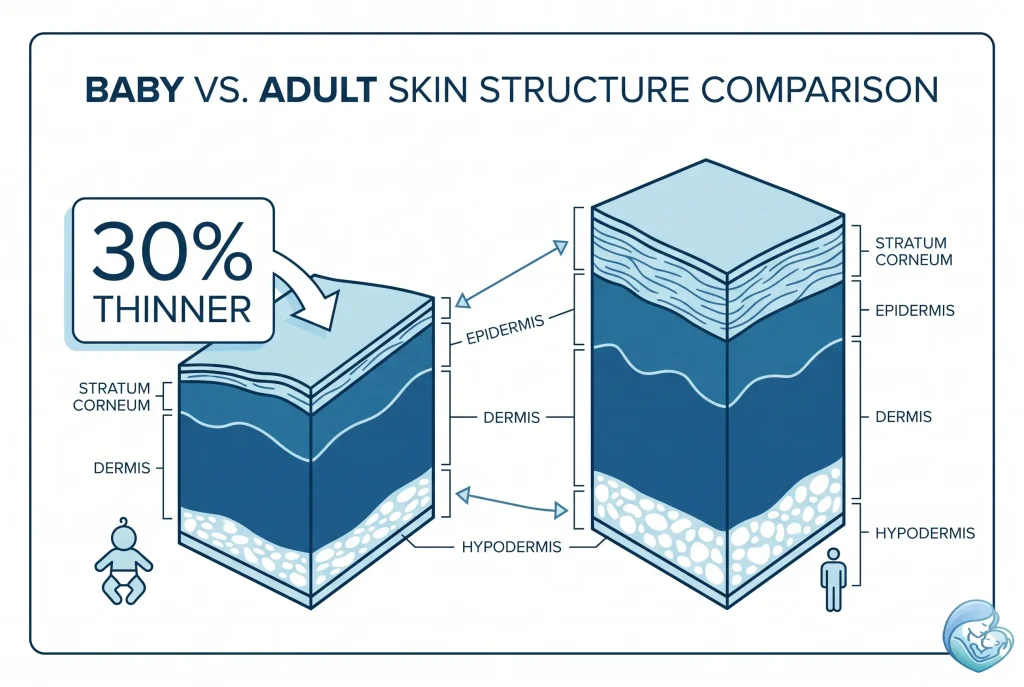
Baby skin is roughly 30% thinner than adult skin. That's not a small difference. That's a structural difference that changes how skin absorbs substances, how it responds to irritants, how it regulates temperature, and how quickly it loses moisture. The baby skincare industry knows this. It just doesn't mention it when it's selling you a $22 lotion that smells like vanilla and lavender.

Let's talk about what this actually means.
Section 01: The 30% Reality
The biology they don’t put on the label
This isn’t a marketing claim pulled from a moisturizer ad. Neonatal skin is measurably, structurally different from adult skin in ways that matter enormously for what you put on it. The research here is consistent and not particularly controversial. What’s controversial is how rarely this information reaches parents before they buy a full skincare system from a brand that’s counting on them not knowing it.
It’s Not Just About Sensitivity
When we say baby skin is thinner, we mean the stratum corneum — the outermost layer that acts as the body’s barrier — is less developed. Here’s what follows from that:
-
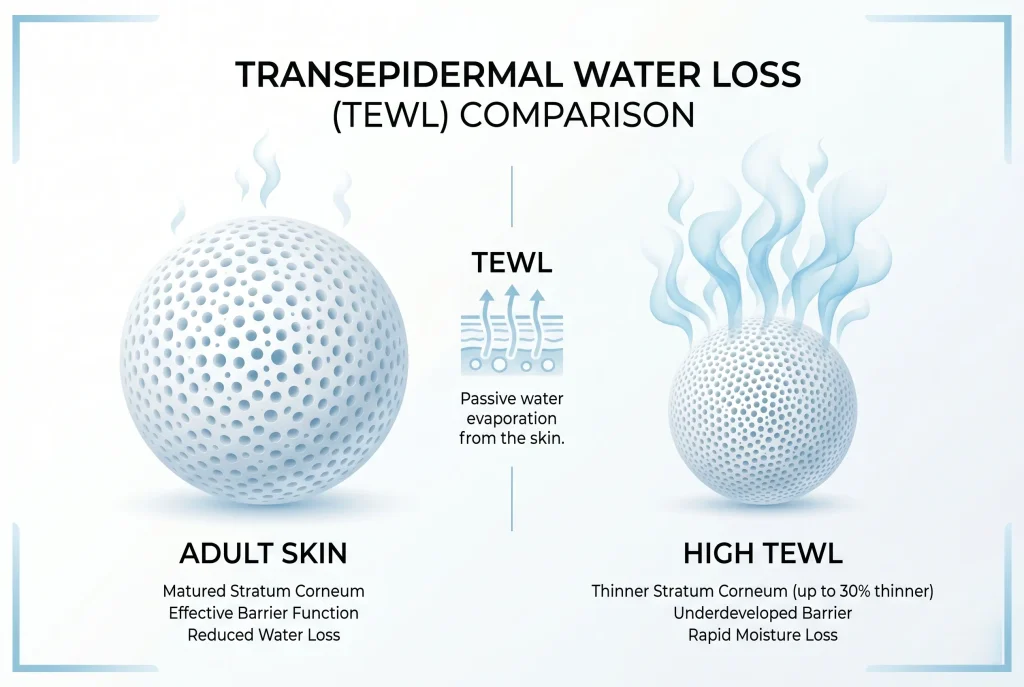
Higher transepidermal water loss (TEWL). A thinner, less mature barrier lets water escape more easily, meaning baby skin dries out faster. This is why newborn skin that looks perfectly fine can become dry and flaky quickly — not because it needs a rich moisturizer, but because the barrier can’t yet hold moisture the way adult skin does.
-
Faster and deeper absorption of topical substances. The same barrier that struggles to keep moisture in also struggles to keep things out. Chemicals applied to baby skin are absorbed more rapidly and in greater quantities than they would be on adult skin. This is the number that matters most when you’re reading an ingredient list.
-
Higher surface-area-to-body-weight ratio. A baby is small but has proportionally more skin relative to their body mass than an adult. More skin + more absorption per unit = more systemic exposure to anything applied topically. What seems like a small amount to you is proportionally significant to them.
-
Developing microbiome. The skin’s microbiome — the colony of bacteria that helps regulate the immune response and barrier function — is still establishing itself in the first months of life. Introducing unnecessary ingredients disrupts this process. This is another reason less is more, not a marketing slogan but a biological instruction.
📐 The Bottom Line on Absorption
When a fragrance molecule, a preservative, or a surfactant touches your baby's skin, it goes in faster, goes in deeper, and affects a proportionally larger system than the same substance would on your own skin. This is why the ingredient list on a baby product matters more than the ingredient list on anything you buy for yourself.
Section 02: Why “Baby Smell” Is a Red Flag
The most effective marketing in the skincare aisle
The smell of a baby product is doing exactly one thing: it’s making you feel good about buying it. That’s it. That is the entire functional purpose of fragrance in a baby lotion, a baby wash, a baby wipe, or a baby anything. Fragrance is not a functional ingredient. It does not moisturize. It does not protect. It does not clean. It smells nice to the adult who buys it, and it irritates the skin of the child who wears it.
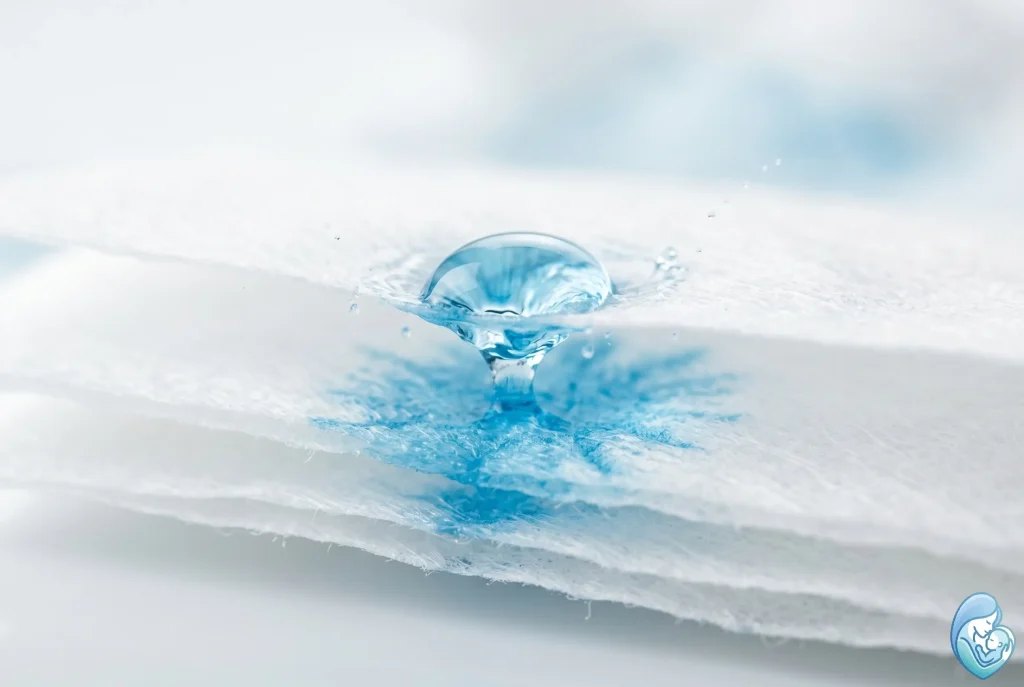
The Word “Fragrance” on an Ingredient List Can Represent Hundreds of Individual Chemical Compounds.
In the US, “fragrance” is a legally protected trade secret. Companies are not required to disclose what’s inside it. A single listing of “fragrance” can contain up to 3,000 possible chemical ingredients — many of which are known allergens and skin sensitizers. This is fine for a candle. It’s not fine for something being rubbed onto skin that absorbs at a higher rate than an adult’s.
And here’s the specific problem for babies: fragrance is the number-one cause of contact allergies in pediatric skin. The sensitization often doesn’t show up immediately — it builds with repeated exposure. By the time you notice a reaction, the damage to the developing skin microbiome and barrier has already been done.
“Fragrance” or “Parfum” anywhere in the ingredient list. Doesn’t matter if the product is labeled “gentle” or “natural” or “pediatric.” If fragrance is in it, it doesn’t go on baby skin.
Essential oils listed individually — lavender, chamomile, ylang-ylang, rose. These are not safer than synthetic fragrance. Lavender and tea tree oil are documented endocrine disruptors in prepubescent children. “Natural” fragrance is fragrance.
“Naturally derived” scent or “botanical fragrance.” Marketing language designed to make fragrance sound harmless. The skin doesn’t care about the origin story. An allergen derived from a plant is still an allergen.
Fragrance-free products — not “unscented” (unscented can still contain masking fragrances), but genuinely fragrance-free. Short ingredient lists. No botanical oils. No parfum. The product should smell like nothing.
The product smells good so you'll buy it. Your baby pays for that decision with their skin barrier.
— not a conspiracy theory, just incentive structures working exactly as designed.
Section 03: The 3-Item Minimalist Kit
What you actually need. The complete list.
This is the section where I tell you that building a science-based baby skincare routine requires restraint, not abundance. For the first three months, you need exactly three categories of products. Not a system. Not a routine with five steps. Three categories, one product each, chosen on the basis of ingredient simplicity rather than packaging sophistication.
For the first month of life, water is the only thing a healthy newborn’s skin needs for daily cleansing. No wash, no soap, no wipes unless changing a diaper. Lukewarm water on a soft cloth removes surface residue without stripping the natural vernix and early microbiome. This is what dermatological societies recommend. It is boring and it costs nothing and it is correct.
After week four, a single gentle cleanser for bath time. The criteria: fragrance-free, sulfate-free, pH-balanced for baby skin (around 5.5), and a short ingredient list. CeraVe Baby Wash and Shampoo or Mustela Gentle Cleansing Gel meet this bar. Check the ingredient list every time — formulations change. If “fragrance” has appeared since you last checked, find a new one.
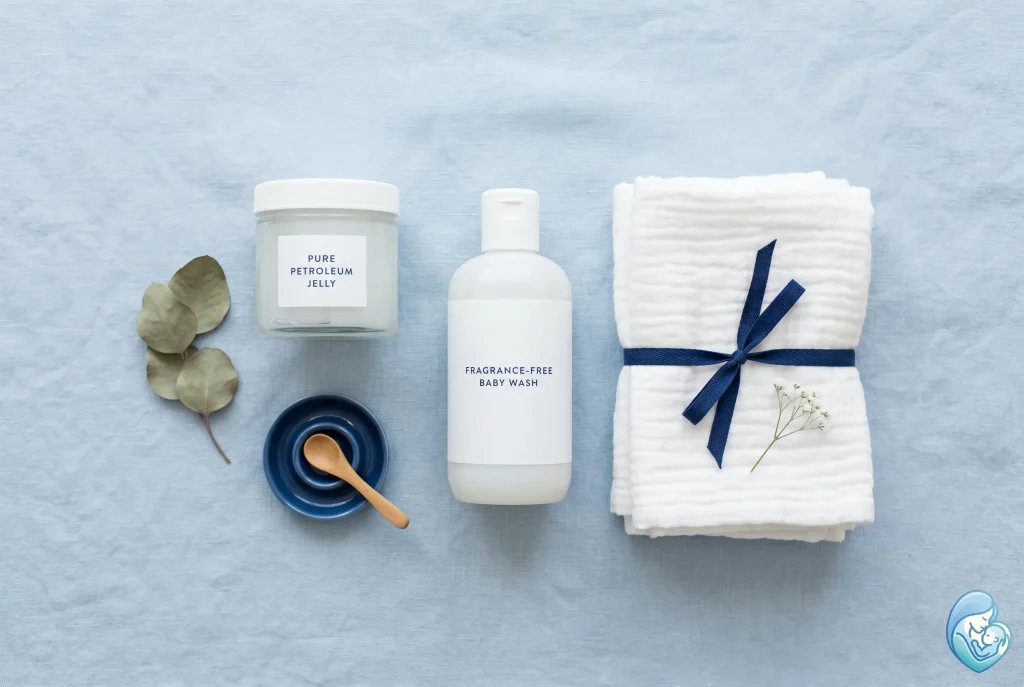
Only when needed — dry patches, diaper area, windburned cheeks. Plain petroleum jelly (Vaseline) is dermatologist-endorsed, cheap, fragrance-free, and highly effective as a barrier. For diaper rash specifically, zinc oxide paste. For dry patches, plain Vaseline or a fragrance-free petrolatum balm. You do not need a dedicated face cream, a body lotion, and a specialized night balm. One barrier product covers every use case.
✓ The entire shopping list
Soft washcloths. One bottle of fragrance-free baby wash (for when water alone isn't enough). One tube of plain Vaseline or fragrance-free zinc oxide paste. That is genuinely it for months zero through three. Total cost: under $20. Everything else is a product your baby's skin did not ask for.
What about wipes?
Wipes occupy their own category because they’re used at every single diaper change — which means the skin contact is constant, repeated, and cumulative over the course of a day. For a baby with intact, healthy skin, the bar for wipes is already high. For any redness, sensitivity, or rash: 99.9% water wipes only.
WaterWipes remain the benchmark — water and a trace amount of fruit extract, nothing else. The principle matters more than the brand: you want as close to water on a cloth as you can get, in a format that works at 3 AM without requiring you to wring anything out. The cleaner the ingredient list, the less your baby’s skin is exposed to during the thousands of diaper changes in year one.
🔬 The cumulative exposure point
The average baby is changed 8–10 times per day in the newborn period. That's 8–10 wipe applications per day to skin that absorbs more and protects less than adult skin. If each of those wipes contains fragrance, a preservative, and a surfactant, the cumulative daily exposure adds up quickly. This is the math the scented wipe industry doesn't include in its "gentle formula" marketing.
-
Baby skin is ~30% thinner than adult skin. This means it absorbs topical substances faster and at higher rates, loses moisture more easily, and is more vulnerable to sensitization from repeated ingredient exposure.
-
Fragrance is the single biggest avoidable risk in baby skincare. It serves no functional purpose. It’s the leading cause of contact allergies in infants. “Natural fragrance,” botanical oils, and essential oils are not exempt — the skin doesn’t care about origin stories.
-
The smell of a baby product is for you, not for your baby. It’s a sales tool. Any product that smells appealing contains something your baby’s skin would be better off without.
-
Three categories. That’s the whole kit. Water for cleansing newborn skin. One fragrance-free, pH-balanced wash. One basic barrier (Vaseline or zinc oxide). Everything else is a product that exists to extract money from parents who are anxious and love their children — which is to say, all of us.
-
For wipes, the bar is the same. Fragrance-free always. 99.9% water wipes during any rash or sensitivity. 8–10 wipe applications a day is a lot of cumulative ingredient exposure — keep the list as short as possible.
-
The minimalist approach isn’t deprivation. It’s protection. The less you put on developing skin during the first months of life, the better the microbiome establishes itself, the lower the risk of sensitization, and the simpler your bathroom cabinet. Three items. Under $20. Start there.
Disclaimer: This post is for informational purposes only and is not a substitute for medical or dermatological advice. Always consult your pediatrician about your baby’s specific skin needs. No botanical serums were given a fair trial before being dismissed.