

And What to Leave in the Store — because the feeding aisle is 40% good products and 60% neon plastic solutions to problems you don't have yet.
I want you to imagine walking into the feeding aisle of a baby store for the first time. Take a moment. Really picture it. The colors. The screaming primary reds and yellows. The packaging that shows a beaming baby happily accepting a spoonful of something green while their parents look on with an expression of serene accomplishment that no parent has ever actually worn at dinnertime.
There are warming bowls that plug in. There are spoons that change color when the food is too hot — an innovation that costs $14 and solves a problem your wrist could solve in one second. There are suction bowls that don’t suction. There are straw cups that require an engineering degree to disassemble and a full day to dry. There are mesh feeders that I will address specifically in this article because the mesh feeder situation deserves its own paragraph.
You are preparing to offer mashed food to a small person who has no teeth and no opinion about the equipment. You do not need a specialized kitchen. You need five things that actually work, one storage hack, and the information to leave everything else exactly where you found it.
Section 01: The Big 5 Essentials
The complete list for starting solids essentials — no accessories, no bundles, no “complete systems”
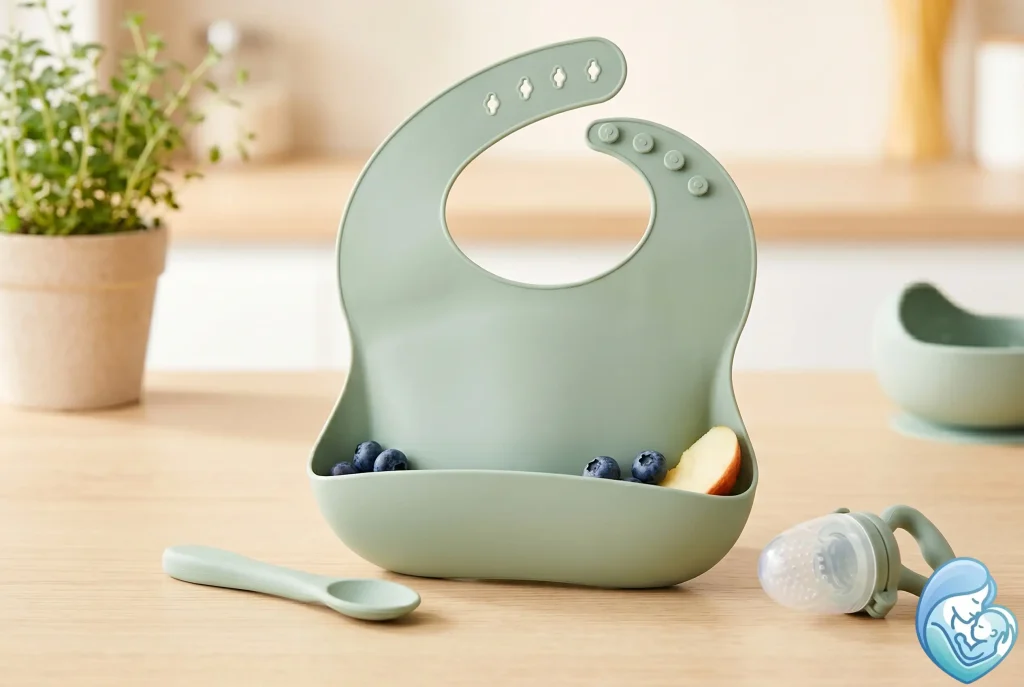
The pocket is not optional. The pocket is the entire point. Cloth bibs absorb. Bibs with shallow “lips” let food roll onto the high chair tray anyway. What you want is a silicone bib — one piece, no seams — with a deep forward-facing pocket that actually catches the food that misses the mouth, which will be most of it for the first few weeks.
One wipe-clean bib is better than six cloth bibs. Get two. One in use, one drying. The Bumkins or Mushie silicone bibs hit this mark without the premium price tag of designer options that do the same thing with a better logo.
// Avoid: bibs with velcro at the back. Velcro and laundry are enemies. Snap closures or simple neck loops only.Infant gums are cartilage. Metal spoons, hard plastic spoons, and novelty spoons shaped like tiny aeroplanes are all wrong. Soft silicone, period. The material compresses slightly on contact, which is comfortable and doesn’t jar sensitive gum tissue during the early weeks when babies are still figuring out what a spoon even is.
The handle length matters more than most guides acknowledge. Short handles are better for self-feeding because a 7-month-old doesn’t have the wrist control to manage a long-handled spoon — the bowl end ends up anywhere but their mouth. Short-handled spoons like the NumNum Pre-Spoon GOOtensil or Mushie tiny spoon put the food delivery mechanism closer to the hand doing the controlling. Which is still their fist. But it helps.
// Buy 4–6. They disappear. This is a law of physics that applies only to baby spoons and socks.The phrase “suction plate” has been applied liberally to products that barely meet the definition. Most suction plates suction to the tray for approximately ninety seconds before your baby discovers, with genuine delight, that they can launch the whole thing onto the floor like a small, grinning trebuchet.
What you need is a plate with a proper silicone base that creates a genuine seal — not a symbolic one. Mushie Happy Mat is the genuine article here. The whole mat suctions to the table in one press and requires deliberate adult-level effort to remove. It also has divided sections, which is useful for when you’re doing multiple foods and don’t want them to merge into a single mysterious compound.
// One plate. One bowl. That’s the whole collection. They clean in the dishwasher. Skip the matching 7-piece set.The sippy cup exists for one reason: it doesn’t spill. That’s a parent benefit, not a developmental one. Speech-language pathologists are consistent on this point — the sippy cup trains a sucking and thrusting tongue motion that actively works against the oral motor development children need for speech and mature swallowing. Children who drink from sippy cups for extended periods develop the same pattern as bottle-feeding without the nutritional justification for it.
The alternatives: a small open cup (yes, it spills; yes, this is fine; yes, they learn faster than you’d think) or a 360° cup that requires lip seal rather than sucking. The Munchkin Miracle 360 is the standard recommendation from pediatric speech therapists for the transition from bottle. It spills less than an open cup and doesn’t train the wrong oral motor pattern.
// Start with sips of water from a tiny open cup from day one of solids. It’s messier than a sippy. The developmental outcome is worth it.The floor under a high chair during starting solids looks, by day three, like the aftermath of a small natural disaster. Purée finds grout. Pea soup finds baseboards. You will need something between the chair and the floor that you can clean without despair.
A dedicated splash mat — a thin, washable, wipe-clean mat that sits under the high chair — works well. The Mushie Tiny Splash Mat is the product category’s obvious recommendation. An old beach towel or a folded shower liner also works and costs nothing. The beach towel goes in the wash. The shower liner gets shaken and wiped. Neither requires a dedicated purchase. I’m telling you both options because I am committed to you spending less money than the feeding aisle wants you to spend.
// If your floors are hardwood: waterproof liner under a washable fabric mat. The texture reduces slipping and the liner prevents the purée seeping into the wood.Section 02: The Marketing Trash List
Products you will see, want, and should not buy
I do not enjoy being negative about products without reason. I am negative about these products with extensive reason. We’ll go fastest on the mesh feeder because the mesh feeder requires its own warning box.
A mesh bag on a handle into which you stuff food so a baby can gum at it. The concept is functional. The cleaning reality is a nightmare I have documented below. The short version: banana dries into a cement-like substance inside mesh. There is no getting it out. The feeder becomes a mold incubator. See the warning.
Silicone trays with small compartments, sold specifically as “baby food storage,” priced at $25 because they have a baby on the packaging. A standard silicone ice cube tray costs $6 and makes the same size portions. Each cube is roughly one ounce — exactly right for early portions. The baby does not know what brand of silicone held their purée.
We have been here before. The immersion blender is $35, easier to clean, and lasts fifteen years. The dedicated baby food maker lasts the purée phase and then sits in a cabinet.
The banana cement problem. Banana is one of the most common first foods and one of the worst things you can put in a mesh feeder. It oxidizes and dries into a sticky, brown, near-impermeable layer inside the mesh weave. Running water does not remove it. A toothbrush helps, barely. After three uses, you are cleaning something that looks and behaves like grout.
The mold timeline. Mesh feeders have a seam where the bag meets the handle. Food residue gets into this seam regardless of how carefully you clean. Within one to two weeks of regular use, black mold develops at this junction. This is not hypothetical — it appears in the reviews of virtually every mesh feeder on the market. You are feeding your baby something that touches a mold-producing seam.
The alternative that solves the actual problem. The mesh feeder exists so babies can gum at food without receiving a large piece that could be a choking hazard. A silicone feeder — same concept, smooth surface, no mesh — solves the cleaning problem completely. Or: soft-cooked finger food in an appropriate size. The mesh feeder is not the only solution to the problem it claims to solve.
The feeding aisle is designed to make you feel underprepared. You are not underprepared. You have a fork and a clean bowl.— This is genuinely sufficient for the first two months of solids.
Section 03: Liza’s Practical Hack
The storage solution nobody includes in the registry guides
Let’s talk about where you’re going to put the food you make, because this is another area where the industry has invented solutions to simple problems and charged a premium for them. The minimalist baby feeding gear answer for storage is embarrassingly straightforward.
Dedicated “baby food containers” are small, plastic, often hard to seal, and single-purpose. There is a better option that costs less, stores better, and you will use for the next decade.
4oz Ball Mason jars are the correct size for early portions. One jar = one feeding. The wide-mouth versions allow a spoon to reach the bottom. They stack in your freezer, label with a marker, thaw in the fridge overnight.
Plastic-free by default. No leaching, no degradation, no replacing when they get cloudy. Glass stays glass. For parents who are trying to reduce plastic in the feeding environment, this is the zero-effort solution.
Usable for years after the solids phase. When your child stops eating puréed carrot, the jars become snack containers, yogurt portions, juice glasses for toddlers, salad dressing jars in your own fridge. A $12 investment that serves your household for a decade.
Find them on Amazon, at Target, or at any grocery store. Search “Ball 4oz Mason Jars wide mouth” — typically sold in 12-packs for $10–14. This is the entire storage purchase. You are done.
Conclusion: The Baby Doesn’t Care About the Brand
A closing argument for keeping it simple
Here is the thing that the feeding aisle, the sponsored content, and the “complete starting solids system” bundles don’t want you to dwell on: your six-month-old is experiencing food for the first time. They have never tasted anything except milk. A piece of steamed sweet potato is, to them, a genuinely astonishing event. The equipment is not the experience.
What they will remember — in whatever diffuse, preverbal way babies remember anything — is whether feeding was relaxed or anxious. Whether the person across from them was present and calm or frantically consulting an instruction manual. The silicone spoon and the suction plate exist to reduce friction in that moment, not to create it.
✓ The complete minimalist list
2 silicone bibs (deep pocket) · 6 soft silicone spoons (short handle) · 1 suction mat/plate that actually seals · 1 open or 360° cup · 1 splash mat or old towel · 12 small glass jars for storage. Total spend: under $80. That is every piece of equipment you need to start feeding your baby real food for the first time.
📌 Before you close this tab
Check if you already own half this list. Silicone bibs are sometimes gifted. Glass jars might already be in your pantry. The splash mat might be an old towel in your linen closet right now. Starting solids requires less new gear than the industry suggests. Often, it requires almost none.
-
Five things, full stop. Silicone bib with a deep pocket. Soft short-handled silicone spoons. A suction plate that actually suctions. A 360° or open cup. A splash mat or towel. That’s the complete starting solids toolkit.
-
Skip the sippy cup. Speech therapists are consistent: sippy cups train the wrong oral motor pattern. A 360° cup or an open cup takes more attention but produces better developmental outcomes.
-
The mesh feeder goes in the bin. Or never comes out of the store. Either way, banana cement plus mold plus a seam that can’t be cleaned is not a product you want near your baby’s mouth. Silicone feeder if you need the concept; soft finger food if you don’t.
-
4oz glass Mason jars beat every dedicated baby food container. Cheaper. Plastic-free. Freezer-safe. Reusable for years. This is the storage conversation, finished.
-
The elaborate steamer-blender is still a lie. If you missed that post, it’s in the Feeding category. The immersion blender costs $35 and cleans in thirty seconds. Everything else is a two-month purchase with a fifteen-year cleaning commitment.
-
The goal is a relaxed meal, not a perfectly equipped one. Your baby will eat sweet potato off a plate from your kitchen whether it’s a EZPZ mat or a regular bowl. Focus on the food, the calm, and the moment. That’s what starting solids actually is.
Disclaimer: This post contains Amazon affiliate links. Purchases may earn a small commission. All recommendations are based on personal use, research, and genuine skepticism of anything that requires descaling. The Mason jar recommendation is not sponsored. It is just correct.